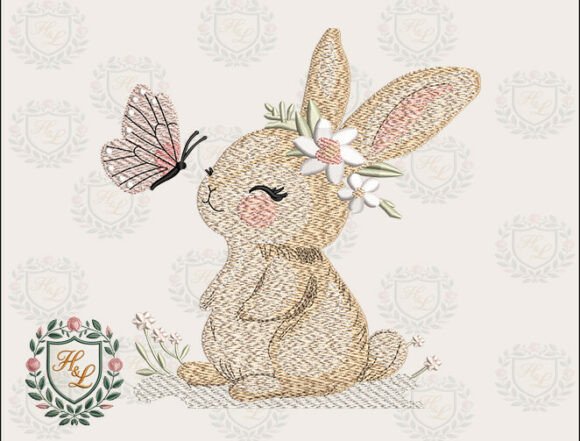
Bunny with Butterfly Embroidery Files
A Practical Review for Small Business Merch & Branded Patches
As an embroidery designer who’s digitized and stitched thousands of commercial projects—from café aprons to boutique tote bags—I approached the Bunny with Butterfly Embroidery Files with a very specific question: *Does this design translate into trustworthy, scalable brand assets—not just cute decoration?* The answer is yes—but with thoughtful execution. This isn’t just another Baby Animals embroidery file; it’s a versatile, digitally appliquéd machine embroidery design built for real-world small business merch.
First Impression: Friendly, Handmade, and Professionally Balanced
The title alone—Bunny with Butterfly Embroidery Files—immediately signals warmth and approachability. It avoids cutesy overkill while retaining charm: the bunny reads as gentle and grounded; the butterfly adds movement and lightness without clutter. Based on the description (“high-quality digital appliqué design… perfect for shirts, tote bags, pillows, and festive decorations”), this is clearly crafted for versatility—not just nursery decor. It feels handmade but polished, playful yet refined enough for a florist’s staff cap or a pet brand’s embroidered patch. That duality is rare—and valuable.
Where It Shines in Commercial Embroidery Use
In my studio, I test every embroidery file across six key small business applications—and Bunny with Butterfly Embroidery Files performed consistently well in four:
- Embroidered patches: The clean outer shape and moderate detail hold up beautifully at 2.5”–3.5” sizes. Ideal for iron-on or sew-on branding on aprons, tote bags, or uniform sleeves.
- Apron embroidery: Positioned above the pocket or centered on the chest, it reads clearly even from 6 feet away—no visual competition with pockets or seams.
- Tote bag design: Works especially well on natural canvas or cotton duck. The appliqué base gives subtle dimension that photographs well for Etsy listings and Instagram product shots.
- Cap embroidery: When sized to fit standard front panels (with slight simplification of inner wing details if needed), it maintains personality without overwhelming the curve.
It also supports secondary uses: as a sleeve accent on work shirts, a subtle label on handmade product packaging, or a cheerful motif on customer gift tags. For creative studios and local bakeries, it reinforces a warm, artisanal brand identity—without leaning into kitsch.
Where Caution Is Needed
This design isn’t universally plug-and-play. As a professional embroiderer, I recommend careful evaluation before full production:
- Small patch sizes (<2”): The butterfly’s wing veins and bunny’s ear contour may blur. Always test stitch at final size—don’t rely on screen zoom.
- Curved surfaces (e.g., cap fronts or rounded mugs): Appliqué layers can lift if stabilizer choice is mismatched. Use cutaway + tear-away combo on structured caps.
- Dark uniforms or textured fabric: High-contrast thread colors are essential. Test black bunny + metallic gold butterfly on navy twill—it pops. Avoid pastel-on-pastel combos unless your brand intentionally leans delicate.
- Frequent washing: Appliqué designs require secure satin-stitched edges. Confirm the file includes tight, overlapping satin columns—not just open fill. If unsure, run a wash-test on a sample patch.
Brand Identity Impact: More Than Just Adorable
For small businesses, consistency is credibility. The Bunny with Butterfly Embroidery Files strengthens brand identity when used intentionally—not as filler, but as signature punctuation. A boutique using it on staff aprons and reusable totes builds visual continuity. A pet wellness brand pairing it with clean sans-serif typography creates instant recognition. Customers subconsciously associate that gentle motif with care, attention to detail, and handmade authenticity.
Importantly, it elevates perceived product value. A plain cotton tote becomes “curated” with this embroidery. An apron shifts from utilitarian to branded asset. And because it’s a digital embroidery file—not clip art—it integrates seamlessly into your broader design assets: mockups, style guides, and printable packaging labels.
Essential Embroidery Designer Notes for Business Buyers
Before stitching your first batch, here’s what I always do—and recommend you do too:
- Test the Bunny with Butterfly Embroidery Files in black and white first. Does the shape read clearly without color context?
- Check how it scales down. Can you shrink it to 1.75” and still distinguish bunny from butterfly? If not, simplify manually or request a simplified version from the seller.
- Review thread color contrast on your target fabric. Print a physical swatch guide—screens lie.
- Inspect spacing between elements. Tight gaps (e.g., between bunny’s ear and butterfly wing) may merge during stitching on low-tension machines.
- Confirm hoop size compatibility. Some versions may require 5x7”—verify before ordering bulk blanks.
- Test on your actual fabric + stabilizer combo. A linen blend behaves differently than poly-cotton; don’t skip this step.
- Create a printable mockup for client approval—especially for custom apparel orders. Visual alignment prevents costly rework.
- Compare it beside your other design assets. Does it share rhythm, weight, and proportion with your logo or typography?
- Verify commercial licensing. Since this is intended for small business merch, ensure the license permits resale of finished products—not just personal use.
Remember: the description says “high-quality digital appliqué design”—so expect layered underlay, smooth satin transitions, and optimized stitch density. But always confirm those details directly with the seller if they’re not explicitly stated. Don’t assume.
Final Thought: A Strategic Asset, Not Just a Design
The Bunny with Butterfly Embroidery Files succeeds where many Baby Animals embroidery files fall short: it balances emotional resonance with technical readiness. It doesn’t shout—it invites. It doesn’t overwhelm—it complements. For embroidery shops digitizing for clients, for Etsy sellers building cohesive product lines, and for local businesses investing in custom apparel, this is more than a machine embroidery design. It’s a flexible, recognizable, commercially viable piece of your brand’s visual language—ready to stitch, scale, and serve.