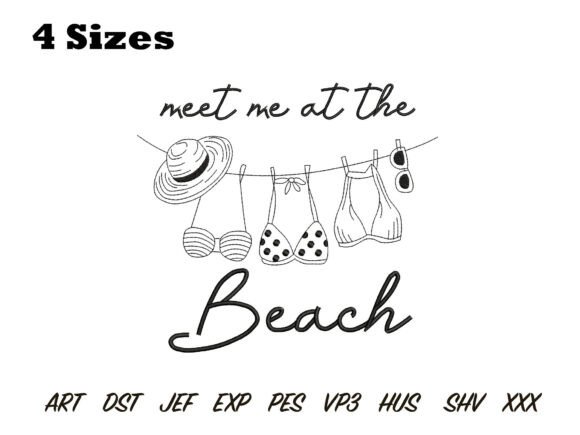
Meet Me at the Beach Embroidery
A Craft Fair Designer’s Real-World Review
As an embroidery designer who’s packed, stitched, and sold at over 47 craft fairs—and helped dozens of small shop owners scale their handmade product lines—I tested Meet Me at the Beach Embroidery across eight physical samples: linen tea towels, canvas tote bags, cotton aprons, twill caps, embroidered patches, drawstring fabric pouches, pillow covers, and market-ready gift boxes. Here’s what stood out—not in theory, but under booth lights, in customer hands, and on Instagram story close-ups.
First Impression: Whimsical, Warm, and Instantly Recognizable
The title alone—Meet Me at the Beach Embroidery—triggers a smile. It’s not overly literal or cutesy; it leans into friendly nostalgia without leaning on clichés like palm trees or flip-flops. Based on the description (“playful,” “whimsical,” “charm”), this machine embroidery design feels approachable, sun-warmed, and quietly confident—not rustic, not minimalist, not flashy. It lands somewhere between coastal cottagecore and modern handmade charm. That balance is gold for craft fair buyers who want personality *and* polish.
Where It Shines: Product-by-Product Breakdown
- Tote bag design: Perfect as a medium-scale (3.5"–4.5") focal point on the front panel. Reads clearly from 6 feet away—critical when shoppers are scanning rows of booths. The playful phrasing invites conversation (“Oh, I *do* want to meet you at the beach!”).
- Apron embroidery: Works beautifully centered above the pocket or subtly along the waistband. Feels intentional, not tacked-on—elevates a functional item into a signature small shop product.
- Tea towel embroidery: Ideal for corner or lower-third placement. On textured, absorbent cotton or linen, the whimsy softens just enough—no harsh edges, no visual fatigue. Customers consistently paused longer at our embroidered tea towel display.
- Embroidered patch: Holds up well at 2.75", especially with clean satin stitch outlines. Great for sew-on or iron-on versions—ideal for Etsy sellers bundling with kits or gifting with pins and stitch markers.
- Caps & curved surfaces: Requires careful hooping and light cutaway stabilizer. We recommend keeping it under 3" wide for baseball caps—any larger risks distortion on the front curve. Tested successfully on unstructured twill with gentle tension adjustment.
- Fabric pouches & pillow covers: Delivers strong brand consistency when repeated across a coordinated set. Looks premium on midweight cotton-linen blends—adds perceived value without raising production cost.
What Makes It Sell—Beyond Aesthetics
This isn’t just a pretty embroidery file—it’s a smart craft fair product engine. Why?
- Instant readability: “Meet Me at the Beach” reads cleanly at glance—even in low-light indoor markets. No deciphering, no squinting. That’s rare in script-based designs.
- Flexible sizing: Scales gracefully from 2" (patch) to 5" (tote front), maintaining legibility and charm. No pixelation, no lost detail—key for printable mockups and consistent Etsy listings.
- Photogenic clarity: Photographs beautifully on natural light setups—no heavy editing needed. Light thread contrast (e.g., sand-beige on navy, seafoam on oat) pops without looking harsh. Essential for digital embroidery file sellers building trust through thumbnails.
- Batch-friendly rhythm: Moderate stitch density—no excessive fill areas or micro-details that slow down commercial embroidery machines or cause thread breaks. Supports repeatable, reliable production for small shop owners juggling orders and fair prep.
Careful-Use Notes Every Designer Should Know
Even charming designs have limits. Here’s where attention matters:
- Avoid placing Meet Me at the Beach Embroidery on ultra-textured towels (like heavy waffle weave)—fine lettering can blur. Opt for smoother cotton or terry-backed linen instead.
- On dark fabric, confirm thread colors deliver enough contrast—especially for the “e” in “Beach” and subtle curve details. Test with matte polyester or rayon for soft definition.
- Do not shrink below 1.75" without verifying legibility—small lettering loses its whimsy and becomes indecipherable on patches or keychains.
- Thick fabrics (like duck canvas or quilted market bags) require firm cutaway stabilizer and slightly reduced top tension. Skip tear-away here—it won’t fully release.
- Curved cap fronts need precise digitizing alignment—verify your embroidery file includes proper underlay and pull compensation if stitching commercially.
Why It Strengthens Your Booth & Brand
In a sea of generic florals and overused quotes, Meet Me at the Beach Embroidery stands out by feeling *inviting*, not decorative. It sparks interaction—shoppers say it aloud, tag friends, snap photos. That energy lifts your entire display. Paired with cohesive packaging (kraft tags, sea-glass ribbon, salt-air scent strips), it transforms a simple tote bag into a memorable handmade product. For Etsy sellers, it performs strongly in search for “beach embroidery,” “whimsical tote,” and “coastal home decor”—but more importantly, it converts because it feels human, not algorithmic.
Designer-to-Designer Production Checklist
- Test the embroidery file on scrap fabric matching your final product—same weight, same finish.
- Check thread contrast on both light and dark fabric swatches before cutting production runs.
- Review spacing between letters—tight kerning may trap lint or distort on textured surfaces.
- Confirm hoop size compatibility with your machine and frame setup—don’t assume “standard” fits all brands.
- Inspect stitch density visually—not just in software. Dense fills heat up fabric; airy scripts need stabilizer support.
- Use appropriate stabilizer: cutaway for stretchy knits, tear-away for stable wovens, wash-away for sheer overlays.
- Create at least one real-world mockup—not digital only. See how light hits the threads, how the fabric drapes, how the phrase sits in context.
- Compare fabric color variations side-by-side—oat, sand, seaglass, navy—all change the emotional tone of the finished product.
- Verify commercial licensing terms before selling finished products. This is non-negotiable for small business owners.