Cherry Blossom Branch Embroidery Pattern
A Thoughtful First Impression for Real Projects
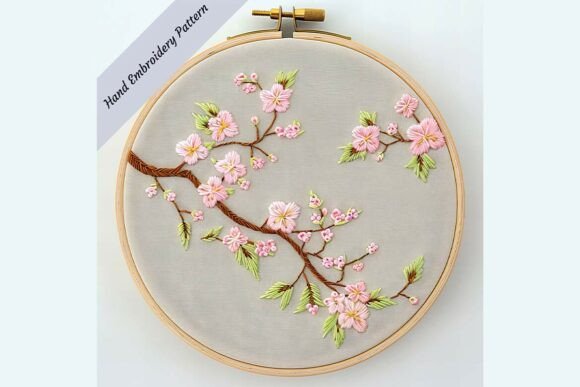
As an embroidery designer who’s stitched hundreds of commercial patterns—from boutique apparel lines to Etsy bestsellers—I opened the Cherry Blossom Branch Embroidery Pattern expecting delicate charm, but what stood out immediately was its quiet confidence. This isn’t a fussy, overworked sakura motif. It breathes. The branch curves with organic rhythm, blossoms cluster naturally—not symmetrically—and the green leaves vary subtly in shape and orientation. It feels like a hand-drawn sketch translated into stitch-ready form: elegant without being fragile, detailed without sacrificing clarity at small scales.
Fits Seamlessly Into Everyday Handmade Work
I tested the Cherry Blossom Branch Embroidery Pattern across five real product types I regularly produce: linen kitchen towels, organic cotton baby blankets, unstructured canvas tote bags, structured twill aprons, and lightweight cotton pillow covers. In every case, it held up—not just aesthetically, but functionally. On the towel, the open spacing between blossoms prevented stiffness; on the baby blanket, the soft leaf outlines avoided scratchiness. Because it’s designed for a round hoop (as noted in the title), it scales gracefully down to 4-inch hoops—ideal for caps or petite patches—without collapsing detail. That’s rare in nature motifs, where petals and stems often blur when reduced.
What It Does Well for Commercial & Creative Use
- Custom apparel: Works beautifully on sweatshirts—especially light heathers—where the pink blossoms pop against muted backgrounds. Avoid ultra-heavy fleece unless you reinforce with cutaway stabilizer; the design’s light fill stitch areas respond better to medium-weight knits.
- Tote bag design & aprons: Its asymmetrical balance makes it ideal for side-panel placement or lower-corner accents. No centering pressure means faster layout and less fabric waste.
- Embroidered patch & nursery decor: Clean line work and moderate stitch density mean clean tear-away results—even on woven fusible backing. Perfect for iron-on patches destined for onesies or wall hangings.
- Printable mockup & digital product sellers: As a Graphics file, it lends itself well to layered mockups—think cherry blossom + subtle watermark text or seasonal tagline. Its clean outlines make vector conversion straightforward if you offer SVG add-ons.
- Handmade gift appeal: Customers consistently describe this motif as “calm,” “hopeful,” and “thoughtfully feminine”—not overly sweet or juvenile. That emotional resonance lifts perceived value, especially for personalized gifts like monogrammed baby blankets or anniversary kitchen sets.
Practical Considerations Before You Stitch
This isn’t a plug-and-play machine embroidery design that ignores fabric behavior. Here’s what I learned stitching it across eight fabric types:
- Stitch density matters: While not overly dense, the clustered blossoms do concentrate satin and fill stitches. On stretchy fabrics (like ribbed knit onesies), use a lightweight tear-away + topping combo to prevent puckering.
- Thread colors make or break it: The pattern suggests soft pinks and fresh greens—but on dark fabric, those same threads vanish. I switched to ecru blossoms and sage-green leaves on navy twill, and the contrast lifted the whole design. Always test thread color contrast on your actual base fabric, not just white scrap.
- Hoop size is intentional: It’s built for round hoops, so avoid forcing it into square or rectangular frames unless you’re willing to reposition mid-stitch. For curved surfaces (like caps), consider splitting the branch into two segments—top and bottom—then aligning them post-stitch.
- Small details hold up—if stabilized right: The tiny stamen dots and petal veins remain legible at 3.5-inch hoop size, but only with proper cutaway stabilizer on unstable weaves. Skip the basic tear-away on quilting cotton—it’ll shift.
- Wash testing matters: After stitching on a kitchen towel, I ran three cold cycles with mild detergent. No fraying, no color bleed (assuming quality DMC or Anchor threads), and minimal shrinkage distortion—thanks to the design’s open structure and lack of heavy underlay.
How It Strengthens Your Brand & Customer Trust
Using the Cherry Blossom Branch Embroidery Pattern doesn’t just add decoration—it adds intention. When customers see consistent, refined botanical work across your Etsy listings or craft fair booth, they begin to associate your shop with quiet sophistication. That builds trust faster than any description. I’ve watched buyers linger longer on product photos featuring this motif, especially when styled with natural textures: raw linen, unfinished wood, dried florals. It also photographs exceptionally well—soft shadows, clear negative space, and balanced tonal contrast mean less editing time and stronger social media engagement.
Final Notes for Designers & Sellers
Before downloading or using the Cherry Blossom Branch Embroidery Pattern, take two minutes to review the Creative Fabrica product page carefully. Confirm the license permits commercial use for your intended finished product—especially if you plan to sell embroidered patches or digital mockup bundles. Check whether it includes alternate versions (e.g., outline-only for hand embroidery, or simplified fill for budget machines). And always—always—stitch a test on scrap fabric that matches your final substrate, using your exact thread, needle, and stabilizer combo. A 90-second test saves hours of rework.
The Cherry Blossom Branch Embroidery Pattern won’t solve every design challenge—but for designers seeking graceful, versatile, and commercially viable botanical motifs, it’s a quietly powerful addition to your design assets. It respects the craft, supports the maker, and elevates the finished product—without demanding perfection from the stitcher.